Concrete Slabs in Waynesboro, VA
Shop floors, garage slabs, shed pads, and equipment pads. The two decisions that matter most on a slab are thickness and vapor barrier, and both are permanent the moment the truck leaves.
Call 540-515-4860 for a free quote – concrete slab Waynesboro. .
Thickness: Match It to What Goes On It
Four inches. Garden shed, small storage building, a pad for a generator or AC unit. Foot traffic and light static loads.
Five inches with rebar on 18-inch centers. The standard for a shop or garage. Handles a car, a lift, a compressor, and normal shop use.
Six inches with heavier steel. A tractor, a dump trailer, a loaded truck, or anything on the heavy side of 10,000 pounds. Also the right call under a two-post lift regardless of what you’re lifting, the load concentrates on four small base plates.
Going from five to six inches costs about twenty percent more concrete. Discovering you needed six after you poured five costs the entire slab.
The Vapor Barrier Is Not Optional
Six-mil polyethylene under the slab, seams lapped and taped. Skip it and here’s what happens: ground moisture wicks up through the concrete continuously. Your slab sweats in humid weather. Tools rust. Cardboard boxes on the floor go soft. Any coating you put down, epoxy, sealer, paint, delaminates from underneath, because the moisture pushes it off the slab.
That last one is what makes it expensive. People pour a shop slab without a barrier, live with it for two years, then pay for an epoxy floor that fails within a season. The coating gets blamed. It wasn’t the coating.

A vapor barrier costs almost nothing at pour time. There is no retrofit.
If the slab is already in place, read about coating or sealing an existing slab before choosing a finish.
Thickened Edges and Footers
If a structure is going on top of the slab, a pole barn, a garage, a carport, the perimeter needs a thickened footer, typically twelve by twelve inches, to carry the wall or post loads. This gets designed with the building.
If it’s a freestanding pad with nothing built on it, a thickened edge is still worth it. The perimeter is where a slab is most vulnerable to undermining and edge cracking.
Permits
Garage or shop slab: Yes, a building permit. In Waynesboro that’s the City; in the county it’s Augusta County Community Development.
Shed pad under a certain size: Usually no permit, but the threshold depends on the structure and its use, not just the pad. Confirm this before you start.
Equipment or generator pad: Usually no permit for the pad itself. The electrical or gas work on top of it is a different trade and a different permit.
We pull the permits on jobs that need them and meet the inspector so you don’t have to take a day off work. (Link to: Augusta County page)
ANCHOR TEXT TO HIGHLIGHT: the words “Augusta County Community Development” earlier in this section.
How a Slab Gets Poured
- Free quote and permit check. We measure, look at access, and tell you what permit applies.
- 811 locate. Before any digging.
- Excavate and base. Dig to depth, place and compact four to six inches of 21A stone.
- Vapor barrier. Six-mil poly, lapped and taped, turned up at the edges.
- Steel. Rebar sized and spaced to the slab’s job, chaired into the middle third. Thickened footers formed if a structure is going up.
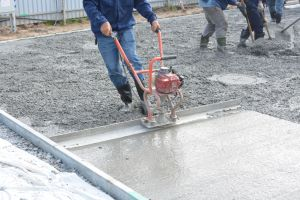
- Pour and finish. 4,000 PSI mix, screeded, floated, and finished, broom for traction or smooth troweled if you’re coating it later.
- Joints and cure. Control joints sawed within twelve hours, cure applied.
What Affects the Cost of a Slab
- Size and thickness. The two biggest drivers.
- Steel. Mesh versus rebar, and spacing.
- Thickened footers. Adds concrete and forming labor.
- Access. If the truck can’t reach it, a pump line adds cost.
- Subgrade. Soft or inconsistent soil may need undercut and replacement.
- Permits. Fees plus the time to file and meet inspections.
See our Pricing Guide for ranges.
Concrete Slab FAQs
How thick should a garage or shop slab be?
Five inches with rebar on eighteen-inch centers for a car, a lift, and normal shop use. Six inches for a tractor, dump trailer, or anything over 10,000 pounds.
Do I need a vapor barrier under a shop slab?
Yes. Six-mil poly. Without it the slab wicks ground moisture continuously, tools rust, and any epoxy or coating you apply will delaminate from underneath. There’s no way to add one later.
Do I need a permit for a shop slab in Waynesboro?
A garage or shop slab needs a building permit. A small shed pad often doesn’t, but the threshold depends on the structure and use. We check before we quote.
How long before I can build on a new slab?
Seven days for framing and light structure. Twenty-eight days before heavy equipment or a lift. The slab hits its rated strength at 28 days.
Can you pour a slab if a truck can’t reach it?
Yes, a pump line, a buggy shuttle, or a shorter-wheelbase truck. All of those cost more and all of them get priced in the quote up front, not discovered on pour day.
Should the slab be smooth or broom finished?
Broom if you’ll walk and work on it as-is, smooth concrete is slick, especially with any oil on it. Smooth troweled if you’re putting down epoxy or tile later, since coatings need a smooth substrate.
Get a Free Slab Quote
Call 540-515-4860 or send your dimensions and what’s going on top.
Email: [email protected]